How I Lost 20 kg in 5 Months With 16:8 Fasting (While Working Full-Time)
I'm Dan, the guy behind danfitnz. I went from 93 kg to about 73 kg in five months — while working a full-time job and training late at night. No coach, no detox tea, no magic supplement. The first month I did almost everything wrong. This post is the honest version: what stalled me, what I changed, the exact numbers I used, and how you can copy the parts that matter.
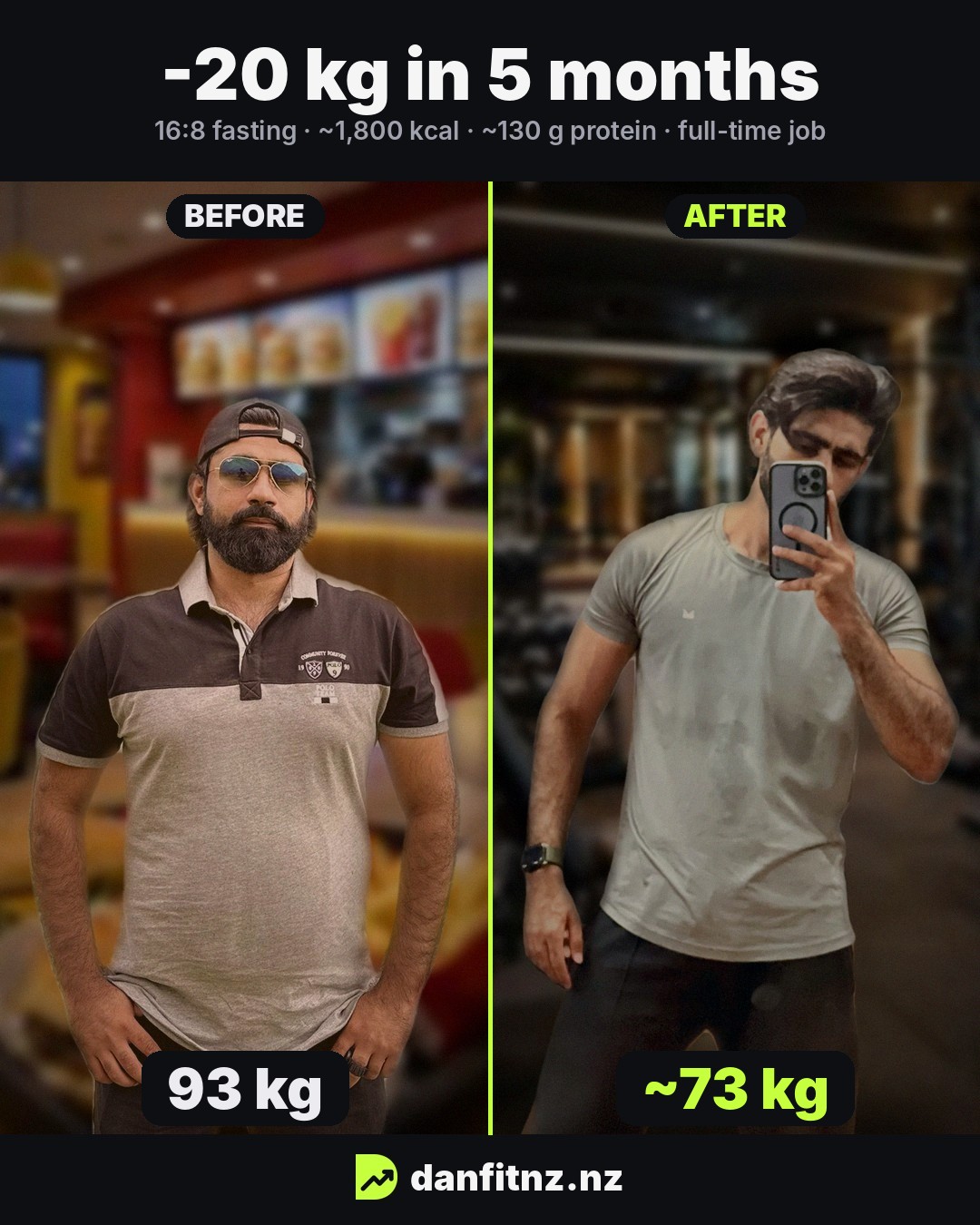
- I lost about 20 kg in 5 months using a 16:8 intermittent fasting window, roughly 1,800 calories and about 130 g of protein a day.
- My first approach — cutting everything — worked for about a month, then my progress stopped.
- What fixed it was structure: a set eating window and actual calorie and protein targets instead of guessing.
- 16:8 is a tool to control calories, not magic. The deficit and the protein did the heavy lifting.
- You don't need to train early or have free time — I trained late at night after work.
Who this is for: Anyone with a job, a family or a busy life who has tried 'eating clean' or cutting everything and got stuck — especially if you're 15–40 kg away from where you want to be.
Where I started: 93 kg and a full-time job
Fitness has always been my passion, but passion doesn't stop the scale creeping up when you work full-time, eat whatever's easy and tell yourself you'll start properly next month. At 93 kg I decided I was done waiting.
My situation is probably like yours: a full-time job, limited energy after work, and training that had to fit in late at night. Any plan that needed 6 am gym sessions or two hours of meal prep a day was never going to last for me. Whatever I did had to work around real life.
Month one: I cut everything — and then it stopped working
Like most people, I started by cutting everything. Fewer meals, almost no carbs, no treats, as little food as I could get away with. And for about a month, it worked — the scale dropped fast.
Then everything stopped. The scale stalled, I was hungry and tired, and training late at night felt terrible. The problem wasn't effort. It was that I had no plan: I was guessing what I ate, swinging between starving and overeating, and I had no idea what my real numbers were.
This is the trap almost everyone falls into. Extreme restriction gives quick early results (a lot of it is water), but it's impossible to keep up, so the real deficit disappears without you noticing. If you've ever 'been strict' and still not lost weight, this is usually why.
What I changed: a proper 16:8 plan with actual macros
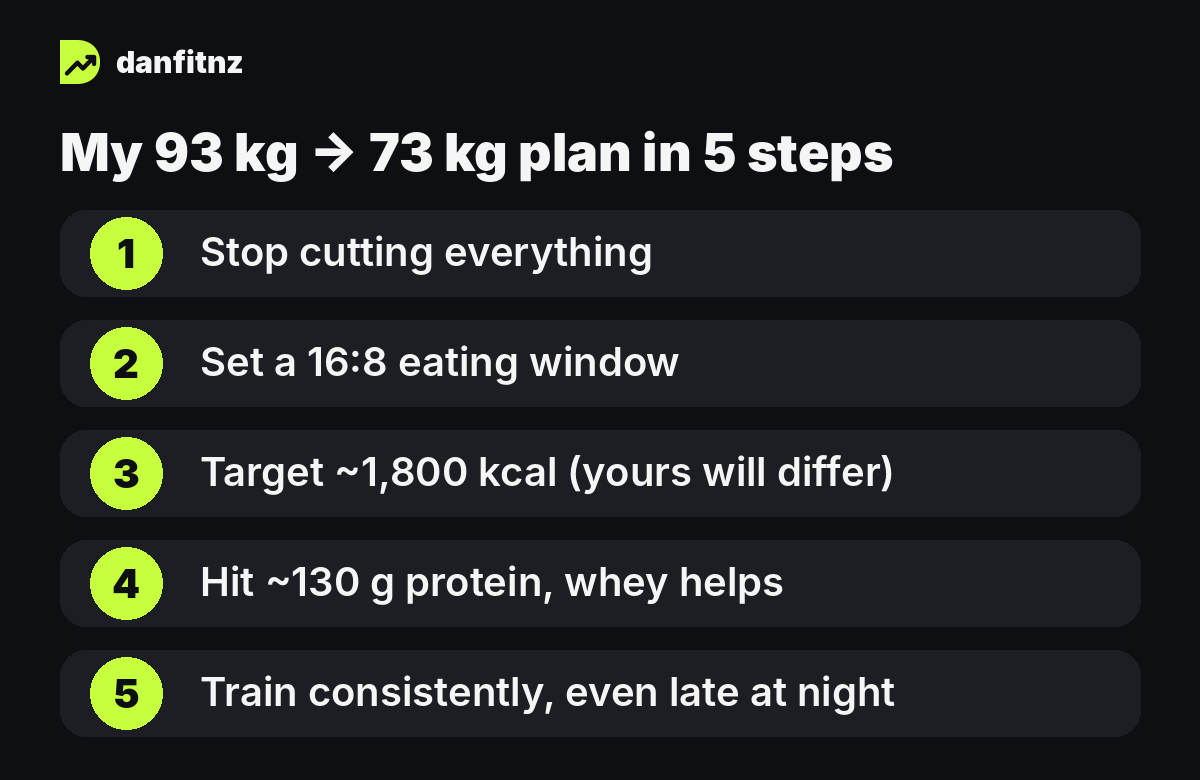
Instead of cutting more, I added structure. I set up a 16:8 intermittent fasting plan — 16 hours fasting, an 8-hour eating window — and, more importantly, I gave myself real targets: about 1,800 calories and about 130 g of protein a day, including whey.
The fasting window made the calories easier. With only 8 hours to eat, there are fewer chances to snack, and two or three proper meals feel more satisfying than six tiny ones. The protein target kept me full and protected muscle while I was losing weight. Having numbers meant that when progress slowed, I could adjust something specific instead of panicking and cutting more.
Find your own numbers, then build a 7-day plan around them.
Calculate my calories →My numbers at a glance
- Starting weight: 93 kg
- After 5 months: about 73 kg (roughly 20 kg lost)
- Eating style: 16:8 intermittent fasting
- Calories: about 1,800 a day
- Protein: about 130 g a day, including whey
- Whey I used: Rule 1, Isopure and Kevin Levrone Signature Series
- Training: late at night, after a full-time job
Is 20 kg in 5 months realistic for you?
It works out to roughly 1 kg a week. That's at the faster end of what's sensible — a common guideline is 0.5–1% of your body weight per week, and at 93 kg, 1% is about 0.9 kg. People with more weight to lose usually lose faster at the start, and it naturally slows as you get lighter.
If you're starting at 70 kg, expect slower progress — maybe 0.3–0.6 kg a week — and that's completely fine. The goal isn't to copy my speed, it's to copy the structure: a moderate deficit you can actually keep, enough protein and training to protect your muscle.
An example day on these numbers
This isn't a meal-by-meal record of what I ate — it's an example of how 1,800 calories and 130 g of protein fit into an 8-hour window with normal food, including desi meals. Use it as a template and swap in foods you like.
- 12:00 pm — Meal 1: omelette with 3 eggs, 2 egg whites, onion, tomato and chilli + 1 roti (about 450 kcal, 35 g protein)
- 3:30 pm — Snack: whey shake with water + 1 banana (about 230 kcal, 27 g protein)
- 7:00 pm — Dinner: chicken karahi made with 200 g chicken and 1 tbsp oil, 1 cup cooked rice, big salad (about 650 kcal, 50 g protein)
- 7:45 pm — Before the window closes: 200 g Greek yoghurt with berries (about 200 kcal, 20 g protein)
- Flexible extras: milk in chai, a piece of fruit, a little extra oil (about 250 kcal)
- Total: roughly 1,780 kcal and 132 g protein
Training late at night after work
I trained late because that's when I had time. It's not ideal on paper, but consistency beats perfect timing. If you train late too, a simple trick is to shift your eating window later (for example 2 pm–10 pm) so your last meal comes after your workout, then sleep. Keep sessions focused: 45–60 minutes of lifting with a few big exercises beats wandering around the gym for two hours.
Lifting matters during a diet. Without it, a good chunk of what you lose can be muscle, and you end up smaller but soft. If you're starting out, our workout library has beginner gym and home workouts with sets, reps and demos.
What actually made the difference
- A fixed eating window, so I wasn't negotiating with myself all day
- Real targets (calories and protein) instead of 'eating clean'
- Protein at every meal, plus whey to make 130 g realistic
- Not cutting everything — I ate normal food, including desi food, in sensible portions
- Weighing myself regularly and looking at the trend, not single days
- Training even when it had to be late at night
What I'd do differently
I'd skip the 'cut everything' month. It cost me motivation and taught me nothing. I'd start straight away with a moderate deficit, a protein target and a simple plan, and I'd track for a few weeks from day one to learn real portions — especially oil, rice and roti, which add up fast in desi cooking.
And I'd remind myself that a stall isn't failure. Weight bounces around with water and salt. Look at the weekly average, and only change something if it hasn't moved for two to three weeks.
How to copy this plan
Start with your own numbers, not mine — 1,800 calories was right for my size, activity and goal, not for everyone. Use the free calorie deficit calculator to find your target, then the protein calculator for your daily protein. If you want it laid out for you, the 7-day plan builder turns those numbers into meals and workouts, including a 16:8 option and desi meals.
Then give it 8–12 weeks before judging it. That's the part nobody wants to hear, and it's the part that works.
Everything in this post is my own experience: 93 kg to about 73 kg in 5 months on 16:8, around 1,800 calories and 130 g protein a day, using Rule 1, Isopure and Kevin Levrone whey, and training late at night after work. Your numbers will be different — use the calculators to set yours.
Your checklist
- Work out your calorie target with the calculator
- Set your protein target (about 1.6–2.2 g per kg)
- Pick an 8-hour eating window that fits your work and training
- Plan 2–3 proper meals with protein in each
- Weigh in most mornings and track the weekly average
- Lift weights 3 times a week
- Review after 2–3 weeks and adjust by 100–150 kcal if needed
Test yourself
Three quick questions — tap to check your answer.
1. What did the most work in Dan's 20 kg loss — the 16:8 window or the calorie deficit?
The calorie deficit (about 1,800 kcal a day) plus enough protein. 16:8 helped by making the deficit easier to stick to — studies show fasting works about as well as normal dieting when calories are matched.
2. Why did 'cutting everything' stop working after a month?
It was too extreme to keep up, so hunger and tiredness crept in and the real deficit disappeared. Early fast drops are also partly water. Structure and real targets fixed it.
3. Someone weighs 70 kg. Should they expect to lose 1 kg a week like Dan?
Probably not. A sensible pace is about 0.5–1% of body weight a week, so 0.35–0.7 kg for them. Slower is normal and fine — use the calorie deficit calculator to set your own target.
Gear that helps
 Rule 1 (R1) Whey ProteinDan's pick — one of the whey brands he used during his 20 kg loss.See it on Amazon →
 Isopure Whey IsolateDan's pick — a whey isolate that's easy on the stomach for many people.See it on Amazon →
 Kevin Levrone Signature WheyDan's pick — another whey he used to hit ~130 g protein a day.See it on Amazon →
 Digital kitchen scaleWeighing food for 2–3 weeks teaches you real portion sizes.See it on Amazon →
 Protein shaker bottleMakes a post-workout shake easy anywhere.See it on Amazon →
FAQ
How much weight can you lose in 5 months with intermittent fasting?
It depends on your starting weight and deficit. A sensible pace is 0.5–1% of body weight a week, so someone at 90 kg might lose 10–20 kg in 5 months. I lost about 20 kg starting at 93 kg.
Is 16:8 better than normal dieting?
Studies show intermittent fasting works about as well as regular calorie restriction when calories are matched. Its advantage is that many people find it easier to stick to — that's why it worked for me.
Do I need whey protein?
No, but it makes hitting a high protein target much easier, especially in a short eating window. Food first, whey to fill the gap.
What should I do if my weight loss stops?
Check the weekly average over 2–3 weeks. If it's truly flat, lower calories by 100–150 a day or add 2,000 steps, and make sure you're not underestimating oil, drinks and snacks.
Sources
- Cioffi I et al. Intermittent versus continuous energy restriction on weight loss and cardiometabolic outcomes: a systematic review and meta-analysis. J Transl Med, 2018
- Lowe DA et al. Effects of time-restricted eating on weight loss (TREAT randomized trial). JAMA Internal Medicine, 2020
- Morton RW et al. A systematic review and meta-analysis of protein supplementation on muscle mass and strength. Br J Sports Med, 2018
- Hall KD et al. Quantification of the effect of energy imbalance on bodyweight. The Lancet, 2011

I'm Dan, an Auckland-based software QA engineer. Fitness is my passion. I went from 93 kg to about 73 kg in five months with 16:8 intermittent fasting, around 1,800 calories and 130 g of protein a day. My first 'cut everything' attempt stalled, so I built a proper fasting plan around real macros. I still train late at night after a full-time job, so everything here is built for busy people.
Keep reading
General information only, not medical advice. Talk to your GP about hormones, medications or health conditions.