How Much Protein Do You Need to Lose Fat? (Real Numbers + Meal Plan)
If a calorie deficit is the engine of fat loss, protein is the steering wheel. Get it right and the weight you lose comes mostly from fat, you feel fuller, and your body looks firmer at the end. Get it wrong and you can lose weight but end up 'skinny-fat', tired and hungry. Here's how much you actually need, how to spread it across the day — even with intermittent fasting — and how to hit it with everyday and desi food.
- For fat loss, aim for about 1.6–2.2 g of protein per kg of body weight per day.
- If you're carrying a lot of extra weight, base it on your goal weight instead.
- Spread it over 2–4 meals of roughly 25–50 g each.
- Protein keeps you fuller and helps you keep muscle while you're in a deficit.
- Whey is a convenient top-up, not a requirement — food first.
Who this is for: Anyone in a calorie deficit who lifts weights or wants to keep their muscle, including people doing intermittent fasting or eating mostly desi home food.
Why protein matters so much when you're cutting
When you eat less than you burn, your body looks for energy everywhere — including muscle. Eating enough protein and lifting weights sends the signal to keep muscle and take the energy from fat instead. Studies comparing higher and lower protein diets during a deficit consistently find better muscle retention with more protein.
Protein is also the most filling macronutrient and takes more energy to digest than carbs or fat. In practice that means fewer cravings and an easier time sticking to your calories.
How much protein do you need?
Research summaries such as the International Society of Sports Nutrition position stand suggest 1.4–2.0 g per kg of body weight per day for active people, and reviews of dieting lifters suggest the top end — or a bit higher — is useful during a deficit. A practical target for fat loss is 1.6–2.2 g per kg.
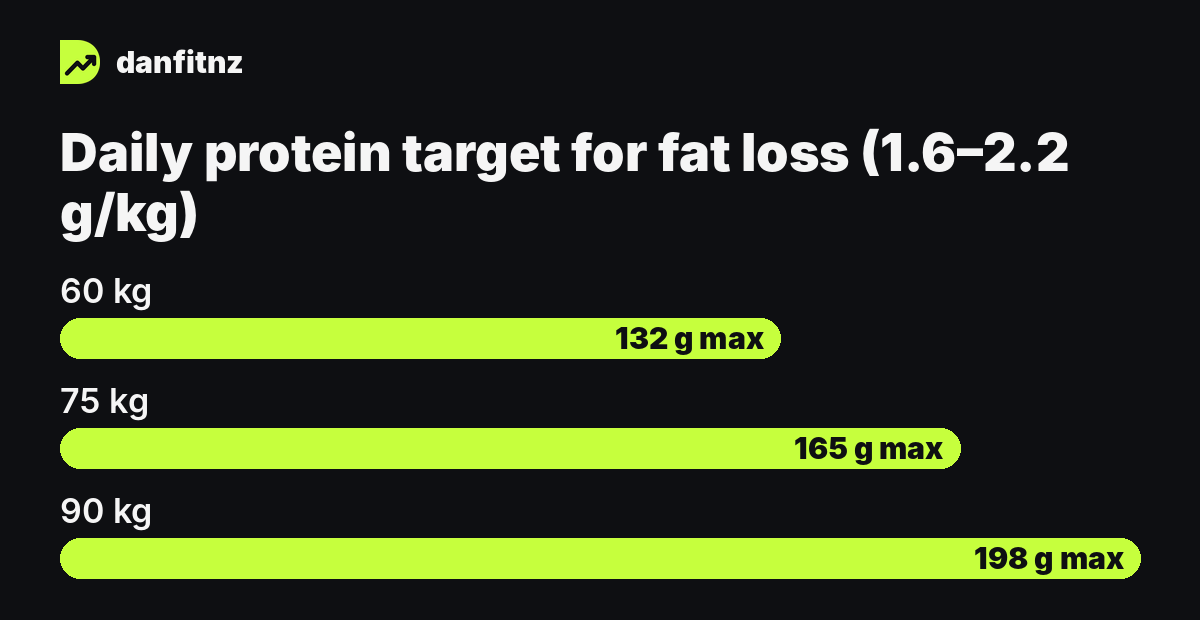
If you have a lot of weight to lose, using your full body weight gives a huge number. Use your goal weight or a 'sensible' weight instead. Someone at 110 kg aiming for 85 kg can base their target on 85 kg: about 135–185 g a day.
- 60 kg → 96–132 g per day
- 75 kg → 120–165 g per day
- 90 kg → 144–198 g per day
A worked example: Priya, 68 kg, desk job, lifting 3x a week
Priya wants to lose about 6 kg. Her protein target is 68 × 1.6–2.2 = roughly 110–150 g. She picks 120 g because it's realistic for her and still in range.
She eats three meals and a snack, so that's about 30–35 g per meal plus a 20 g snack. That turned out much easier than trying to hit 120 g with a protein shake at night and two low-protein meals.
How much protein per meal (and does timing matter?)
Total daily protein matters most. After that, spreading it over 2–4 meals of roughly 25–50 g each is a sensible way to support muscle and stay full.
With intermittent fasting you simply fit those meals into your eating window. On 16:8, for example, two solid meals of 45–55 g plus a 25–30 g snack or shake gets you to 130 g comfortably.
High-protein foods: everyday and desi
Values are approximate and vary by brand and portion — check the label at Countdown, Pak'nSave or New World.
- Chicken breast, 150 g cooked: ≈45 g
- Canned tuna, 95 g tin: ≈20 g
- Eggs, 2 large: ≈12 g (egg whites add ≈3–4 g each)
- Plain high-protein yoghurt, 200 g: ≈20 g
- Paneer, 100 g: ≈18 g (also high in fat — measure it)
- Cooked lentils (dal), 1 cup: ≈18 g
- Chickpeas (chana), 1 cup cooked: ≈15 g
- Firm tofu, 100 g: ≈12–15 g
- Lean beef mince, 150 g cooked: ≈40 g
- Whey protein, 1 scoop: ≈20–25 g
A 130 g protein day (16:8 fasting window, 12pm–8pm)
Here's how a day around 1,800 calories and 130 g of protein can look inside a 16:8 window. Approximate numbers.
- 12pm — first meal (≈45 g): chicken tikka bowl with 150 g chicken, salad, rice and mint yoghurt
- 4pm — snack (≈30 g): whey shake with water or milk plus a piece of fruit
- 7:30pm — dinner (≈55 g): keema with peas made from lean mince, a bowl of dal, 1 roti and salad
- Total: ≈130 g protein
Do you need whey protein?
No — but it's the cheapest, easiest way to add 20–25 g of protein when food falls short. Look for a whey (or whey isolate) with a short ingredient list and around 20–25 g of protein per scoop. If dairy upsets your stomach, a whey isolate or a plant protein can be easier.
Treat it as a top-up, not a meal replacement. Most of your protein should still come from food.
Common protein mistakes
- Front-loading carbs: a breakfast of toast and chai with almost no protein makes the rest of the day hard
- Relying on 'protein' snack bars that are really candy bars with 10 g of protein
- Forgetting portion size: a palm of chicken is often only 20–25 g of protein
- Counting dal or chana as your only protein — great foods, but you need bigger portions or a second source
- Dropping protein when calories drop — protein should stay high while carbs and fats come down
I ate about 130 g of protein a day at around 1,800 calories, inside a 16:8 fasting window, and used whey to top up when meals fell short. The whey brands I've used are Rule 1, Isopure and Kevin Levrone Signature Series — you'll find them in the protein section of the shop.
Your checklist
- Work out your target: 1.6–2.2 g × your body (or goal) weight in kg
- Split it into 2–4 meals of 25–50 g
- Build every meal around a protein source first
- Keep 2–3 easy protein snacks at home (yoghurt, tuna, whey)
- Track protein for 7 days to see where you fall short
- Keep lifting 2–4 times a week
Gear that helps
 Whey protein powderThe easiest way to top up protein when meals fall short.
 Protein shaker bottleMakes a post-workout shake easy anywhere.
 Digital kitchen scaleWeighing food for 2–3 weeks teaches you real portion sizes.
FAQ
How much protein should I eat to lose belly fat?
You can't target belly fat, but enough protein (about 1.6–2.2 g per kg) plus a calorie deficit and resistance training helps you lose fat overall while keeping muscle.
Is 130 g of protein a day too much?
For most healthy adults who are active, no. It's within the commonly recommended range for people around 60–80 kg. If you have kidney disease or another medical condition, ask your GP first.
Can I get enough protein from desi vegetarian food?
Yes, but it takes planning: combine dal, chana, paneer, yoghurt, tofu and milk, and consider a protein powder to fill gaps.
Does protein make you gain weight?
Only if it pushes your total calories above maintenance. In a deficit, more protein helps you keep muscle and stay full.
How much protein can my body absorb at once?
Your body absorbs all of it; the question is how much is used for muscle building at once. Spreading intake over 2–4 meals of 25–50 g is a practical approach.
Should I drink a protein shake after a workout?
It's convenient but not essential. Hitting your daily total matters more than exact timing.
Sources
- Jäger R et al. International Society of Sports Nutrition Position Stand: protein and exercise, 2017
- Morton RW et al. A systematic review, meta-analysis and meta-regression of the effect of protein supplementation on resistance training-induced gains in muscle mass and strength. BJSM, 2018
- Helms ER et al. Evidence-based recommendations for natural bodybuilding contest preparation: nutrition and supplementation. JISSN, 2014

I'm Dan, an Auckland-based software QA engineer. Fitness is my passion. I went from 93 kg to about 73 kg in five months with 16:8 intermittent fasting, around 1,800 calories and 130 g of protein a day. My first 'cut everything' attempt stalled, so I built a proper fasting plan around real macros. I still train late at night after a full-time job, so everything here is built for busy people.
Keep reading
General information only, not medical advice. Talk to your GP about hormones, medications or health conditions.