Calorie Deficit Explained: How Much Should You Eat to Lose Fat?
Every fat loss diet that has ever worked — keto, intermittent fasting, 'clean eating', even the cabbage soup diet — worked for one reason: it put you in a calorie deficit. The diets just disagree on how to get there. If you understand the deficit itself, you can stop diet-hopping and build a plan that fits your life, your culture and your food. Here's exactly how to find your number, how big it should be, and what to do when the scale stops moving.
- A calorie deficit means eating less energy than your body uses. It's the non-negotiable driver of fat loss.
- Aim for about 15–25% below your maintenance calories. For most people that's 300–600 calories a day.
- Expect roughly 0.5–1% of your body weight per week. Faster usually means more muscle loss, hunger and rebound.
- Judge progress by your weekly average weight and waist, never one weigh-in.
- High protein, daily steps and lifting weights make the same deficit far easier to stick to.
Who this is for: Anyone who wants to lose fat without a fad diet, especially busy people who eat a mix of everyday Kiwi food and desi home cooking.
What a calorie deficit actually is
Your body burns energy all day: keeping you alive (your basal metabolic rate, or BMR), digesting food, walking around, and exercising. Add those together and you get your total daily energy expenditure — your 'maintenance calories'.
Eat roughly at maintenance and your weight stays about the same. Eat above it and the extra gets stored. Eat below it and your body makes up the gap from stored energy, mostly body fat if you're eating enough protein and lifting weights. That gap is your calorie deficit.
Notice what's missing from that explanation: no 'bad foods', no magic meal times, no detox. Roti, rice and even the odd takeaway can all fit. What matters is the total across the day and the week.
Step 1: Estimate your maintenance calories
The simplest reliable estimate uses the Mifflin–St Jeor equation for BMR, then multiplies it by an activity factor. You don't need to do the maths by hand — the danfitnz calorie calculator does it for you — but it helps to see how it works.
BMR (men) = 10 × weight in kg + 6.25 × height in cm − 5 × age + 5. For women, use −161 instead of +5. Then multiply by about 1.2 if you're mostly sitting, 1.4 if you're lightly active (desk job plus walking or a few workouts), 1.55 if you're moderately active, and 1.7+ if you have a physical job or train hard most days.
Treat the result as a starting estimate, not a fact. Real maintenance can be 10% higher or lower than any formula. Your own weight trend over two to three weeks is the final judge.
A worked example: Sam, 75 kg office worker in Auckland
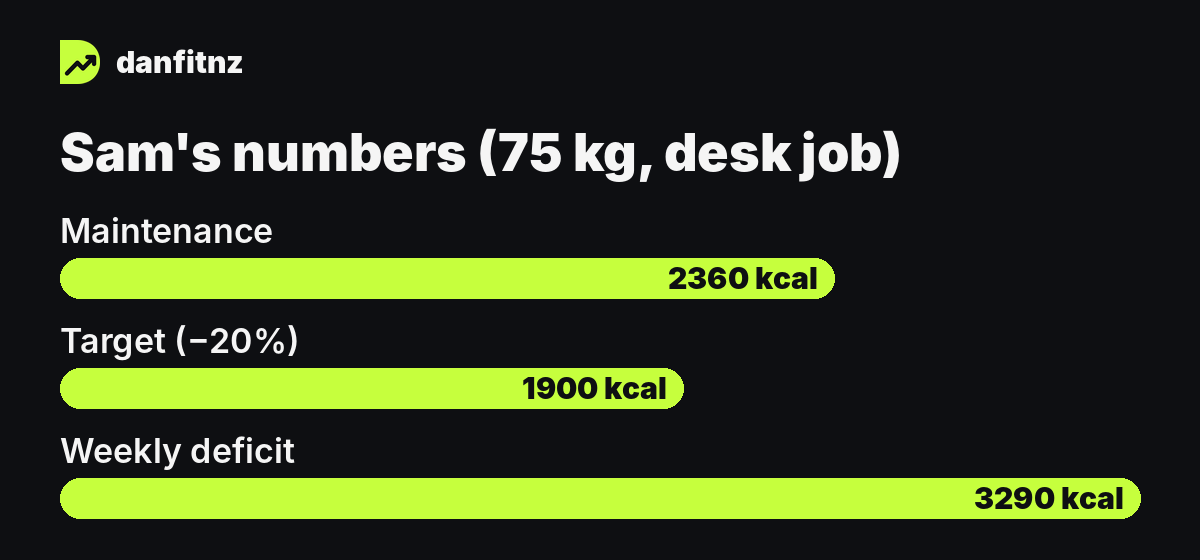
Sam is 32, 175 cm, 75 kg, works at a desk and walks about 6,000 steps a day with three gym sessions a week.
BMR = (10 × 75) + (6.25 × 175) − (5 × 32) + 5 = about 1,690 calories. Lightly active, so 1,690 × 1.4 = roughly 2,360 calories for maintenance.
A 20% deficit is about 470 calories, so Sam's starting target is around 1,900 calories a day. Over a week that's a deficit of roughly 3,300 calories. Using the rough rule that a kilo of body fat stores about 7,700 calories, that's around 0.4 kg of fat per week at the start — right in the sustainable range for a 75 kg person.
In reality the body adapts a little as you get lighter, so expect progress to slow over time. That's normal, not failure.
How big should your deficit be?
Bigger deficits look faster on paper, but research on weight change shows the body pushes back: hunger rises, daily movement drops without you noticing, and you lose more muscle. That's why crash diets so often end in a rebound.
For most people, 15–25% below maintenance is the sweet spot. If you have a lot of weight to lose you can sit toward the top of that range; if you're already fairly lean, stay toward the bottom and expect slower progress.
- Small (10–15%): best for lean people or when you want to keep gym performance high
- Moderate (15–25%): the default for most people
- Large (25%+): only short-term, with high protein, and ideally guided by a professional
What 1,900 calories looks like: a sample day
Here's an example day around Sam's target, mixing everyday NZ supermarket food with desi home cooking. Numbers are approximate — brands and portions vary — but it shows how a deficit can still feel like proper food.
- Breakfast (≈380 kcal, ≈28 g protein): egg bhurji with 2 eggs + 2 egg whites, onion, tomato and chilli, plus 1 wholemeal roti
- Lunch (≈520 kcal, ≈50 g protein): chicken tikka wrap — 150 g chicken breast, salad and a mint-yoghurt sauce in a large wholemeal wrap
- Snack (≈250 kcal, ≈20 g protein): 200 g plain high-protein yoghurt with a banana
- Dinner (≈700 kcal, ≈45 g protein): chicken karahi made with a measured tablespoon of oil, a bowl of dal, 1 cup cooked basmati rice and a big salad
- Total: roughly 1,850–1,900 calories and 140 g protein
Why your weight jumps around (and how to track it properly)
Your weight can swing 1–2 kg from one day to the next because of water, salt, carbs, digestion, hormones and how much you slept. A salty Friday curry can 'add' a kilo overnight that has nothing to do with fat.
Weigh yourself in the morning after the toilet, three to seven times a week, and look at the weekly average. Measure your waist once a week at the belly button. If both are trending down over two to three weeks, your deficit is working.
Common mistakes that kill a deficit
- Guessing oil: a 'splash' of oil in a karahi or stir-fry can be 200–300 calories. Measure it for two weeks and you'll learn what a tablespoon looks like.
- Drinking calories: chai with full-cream milk and sugar, juice, fizzy drinks and alcohol add up fast.
- Weekend blowouts: being perfect Monday to Friday and then eating 1,500 extra calories on Saturday can wipe out most of the week's deficit.
- Cutting too hard: very low calories make you tired and hungry, so training and steps drop and you burn less.
- Only trusting the scale: if your waist is shrinking and the scale isn't, you're probably holding water, not failing.
When fat loss stalls: a simple troubleshooting plan
If your weekly average and waist haven't moved for two to three weeks, work through these in order before changing anything drastic.
- Check you're actually hitting your number — track honestly for 7 days, including oil, drinks and weekend food
- Add steps before cutting food: an extra 2,000–3,000 steps a day is often 100–150 calories
- Then reduce your target by 100–150 calories
- Keep protein high and keep lifting so the weight you lose is mostly fat
- If you've dieted for 12+ weeks, consider 1–2 weeks at maintenance to reset hunger and energy
When I started, I cut everything and it worked for about a month — then it all stopped. What fixed it was a proper plan with real macros: about 1,800 calories and 130 g of protein a day, eaten in a 16:8 fasting window. That's how I went from 93 kg to about 73 kg in five months. My pace was about 1 kg a week; for most people 0.5–1% of body weight per week is a safer target.
Your checklist
- Calculate your maintenance with the danfitnz calculator
- Set a target 15–25% below it
- Hit 1.6–2.2 g of protein per kg of body weight
- Walk 7,000–10,000 steps a day
- Lift weights 2–4 times a week
- Weigh in 3–7 mornings a week and track the weekly average
- Measure your waist every Sunday
- Review after 2–3 weeks and adjust by 100–150 kcal or 2,000 steps
Gear that helps
 Digital kitchen scaleWeighing food for 2–3 weeks teaches you real portion sizes.
 Smart body weight scaleLogs your daily weight so you can watch the weekly average.
 Measuring cups & spoonsStops oil and sauces quietly adding 300 calories.
FAQ
How many calories should I eat to lose weight?
Start about 15–25% below your maintenance calories. For many adults that's somewhere between 1,500 and 2,200 calories a day, but use a calculator and your own weight trend rather than a generic number.
Is 1,200 calories a day too low?
For most men and many women, yes. Very low intakes make it hard to get enough protein and nutrients and usually lead to hunger and rebound. Only go that low with guidance from a health professional.
Can I lose fat eating roti and rice?
Yes. Fat loss depends on your total calories. Measure portions — for example 1–2 roti or about a cup of cooked rice per meal — and pair them with protein and vegetables.
Why am I not losing weight in a calorie deficit?
Usually because the deficit is smaller than you think (untracked oil, drinks or weekends), or because water retention is hiding fat loss. Track honestly for a week and watch your 2–3 week average and waist.
Do I need to count calories forever?
No. Tracking for a few weeks teaches you portion sizes. Many people then switch to a simpler routine like fixed meals, a food scale for oils, and weekly weigh-ins.
Is a calorie deficit safe?
A moderate deficit is safe for most healthy adults. If you're pregnant, have diabetes, an eating disorder history or a medical condition, talk to your GP first.
Sources
- Hall KD et al. Quantification of the effect of energy imbalance on bodyweight. The Lancet, 2011
- NIDDK Body Weight Planner (US National Institutes of Health)
- Helms ER et al. Evidence-based recommendations for natural bodybuilding contest preparation: nutrition and supplementation. JISSN, 2014
- Jäger R et al. International Society of Sports Nutrition Position Stand: protein and exercise, 2017

I'm Dan, an Auckland-based software QA engineer. Fitness is my passion. I went from 93 kg to about 73 kg in five months with 16:8 intermittent fasting, around 1,800 calories and 130 g of protein a day. My first 'cut everything' attempt stalled, so I built a proper fasting plan around real macros. I still train late at night after a full-time job, so everything here is built for busy people.
Keep reading
General information only, not medical advice. Talk to your GP about hormones, medications or health conditions.